



Normal Function
The MYH7 gene provides instructions for making a protein known as myosin heavy chain-7. This protein is found in heart (cardiac) muscle and in certain skeletal muscles, which are the muscles used for movement. Specifically, myosin heavy chain-7 is found in type I skeletal muscle fibers, which are also known as slow-twitch fibers. These fibers are the primary component of skeletal muscles that do not tire easily, such as the muscles involved in maintaining posture.
Myosin heavy chain-7 helps generate the mechanical force that is needed for muscles to contract. It combines with other proteins to form the thick filaments that are found within structures called sarcomeres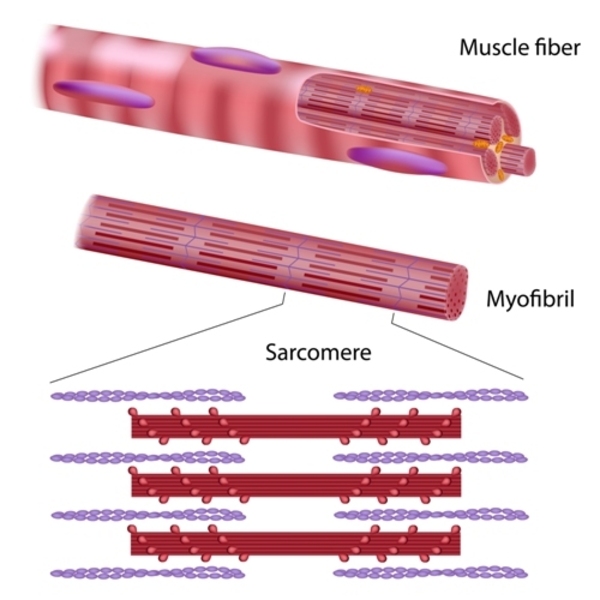 . Sarcomeres are the basic units of muscle contraction; they are composed of overlapping thick and thin protein filaments. These thick and thin filaments undergo cycles of attachment and release, which allow the thin filaments to slide past the thick filaments. These movements shorten the sarcomere, which causes the muscle to contract. Regular contractions of cardiac muscle pump blood to the rest of the body, while the coordinated contraction and relaxation of skeletal muscles allow the body to move.
Health Conditions Related to Genetic Changes
Laing distal myopathy
Genetic changes that cause disease are called pathogenic variants. Pathogenic variants in the MYH7 gene can cause Laing distal myopathy. This condition is characterized by muscle weakness that worsens over time. The weakness typically affects the ankles and toes first but may eventually spread to the hands, fingers, face, hips, and shoulders. Some affected individuals develop dilated cardiomyopathy, a condition in which the cardiac muscle becomes thin and enlarged (dilated).
Many of the pathogenic variants that cause Laing distal myopathy result in changes to a region of myosin heavy chain-7 that interacts with other proteins. However, it is unclear exactly how these variants lead to the muscle weakness seen in people with Laing distal myopathy.
More About This Health ConditionMyosin storage myopathy
Pathogenic variants in the MYH7 gene can also cause myosin storage myopathy. This condition causes muscle weakness that can worsen slowly over time. Pathogenic variants in the MYH7 gene can cause cells to produce a version of myosin heavy chain-7 that does not function properly. The altered proteins accumulate within skeletal muscle fibers, forming protein clumps that can be seen when muscle tissue is removed for examination (muscle biopsy). It is unclear exactly how these changes lead to the muscle weakness seen in people with myosin storage myopathy.
More About This Health ConditionNonsyndromic hypertrophic cardiomyopathy
Pathogenic variants in the MYH7 gene are a common cause of nonsyndromic hypertrophic cardiomyopathy, a condition that is characterized by the thickening (hypertrophy) of the cardiac muscle.
Most of the pathogenic variants in the MYH7 gene that cause nonsyndromic hypertrophic cardiomyopathy lead to the substitution of one protein building block (amino acid) for another in the myosin heavy chain-7 protein. The altered proteins likely do not function properly. However, it is not clear exactly how these changes lead to the hypertrophy that is seen in people with nonsyndromic hypertrophic cardiomyopathy.
More About This Health ConditionCongenital fiber-type disproportion
MedlinePlus Genetics provides information about Congenital fiber-type disproportion
More About This Health ConditionFamilial restrictive cardiomyopathy
MedlinePlus Genetics provides information about Familial restrictive cardiomyopathy
More About This Health ConditionNonsyndromic dilated cardiomyopathy
MedlinePlus Genetics provides information about Nonsyndromic dilated cardiomyopathy
More About This Health ConditionOther Names for This Gene
- CMD1S
Additional Information & Resources
Tests Listed in the Genetic Testing Registry

Scientific Articles on PubMed
Catalog of Genes and Diseases from OMIM
References
- Bahout M, Severa G, Kamoun E, Bouhour F, Pegat A, Toutain A, Lagrange E, Duval F, Tard C, De la Cruz E, Feasson L, Jacquin-Piques A, Richard P, Metay C, Cavalli M, Romero NB, Evangelista T, Sole G, Carlier RY, Laforet P, Acket B, Behin A, Fernandez-Eulate G, Leonard-Louis S, Quijano-Roy S, Pereon Y, Salort-Campana E, Nadaj-Pakleza A, Masingue M, Malfatti E, Stojkovic T, Villar-Quiles RN. MYH7-related myopathies: clinical, myopathological and genotypic spectrum in a multicentre French cohort. J Neurol Neurosurg Psychiatry. 2025 Apr 10;96(5):453-461. doi: 10.1136/jnnp-2024-334263. Citation on PubMed
- Cimiotti D, Budde H, Hassoun R, Jaquet K. Genetic Restrictive Cardiomyopathy: Causes and Consequences-An Integrative Approach. Int J Mol Sci. 2021 Jan 8;22(2):558. doi: 10.3390/ijms22020558. Citation on PubMed
- Claeys KG. Congenital myopathies: an update. Dev Med Child Neurol. 2020 Mar;62(3):297-302. doi: 10.1111/dmcn.14365. Epub 2019 Oct 2. Citation on PubMed
- Dong X, Fan P, Tian T, Yang Y, Xiao Y, Yang K, Liu Y, Zhou X. Recent advancements in the molecular genetics of left ventricular noncompaction cardiomyopathy. Clin Chim Acta. 2017 Feb;465:40-44. doi: 10.1016/j.cca.2016.12.013. Epub 2016 Dec 15. Citation on PubMed
- Finsterer J, Stollberger C, Towbin JA. Left ventricular noncompaction cardiomyopathy: cardiac, neuromuscular, and genetic factors. Nat Rev Cardiol. 2017 Apr;14(4):224-237. doi: 10.1038/nrcardio.2016.207. Epub 2017 Jan 12. Citation on PubMed
- Fiorillo C, Astrea G, Savarese M, Cassandrini D, Brisca G, Trucco F, Pedemonte M, Trovato R, Ruggiero L, Vercelli L, D'Amico A, Tasca G, Pane M, Fanin M, Bello L, Broda P, Musumeci O, Rodolico C, Messina S, Vita GL, Sframeli M, Gibertini S, Morandi L, Mora M, Maggi L, Petrucci A, Massa R, Grandis M, Toscano A, Pegoraro E, Mercuri E, Bertini E, Mongini T, Santoro L, Nigro V, Minetti C, Santorelli FM, Bruno C; Italian Network on Congenital Myopathies. MYH7-related myopathies: clinical, histopathological and imaging findings in a cohort of Italian patients. Orphanet J Rare Dis. 2016 Jul 7;11(1):91. doi: 10.1186/s13023-016-0476-1. Citation on PubMed
- Li N, Zhao Z, Shen H, Bing Q, Guo X, Hu J. MYH7 mutation associated with two phenotypes of myopathy. Neurol Sci. 2018 Feb;39(2):333-339. doi: 10.1007/s10072-017-3192-2. Epub 2017 Nov 24. Citation on PubMed
- Meredith C, Herrmann R, Parry C, Liyanage K, Dye DE, Durling HJ, Duff RM, Beckman K, de Visser M, van der Graaff MM, Hedera P, Fink JK, Petty EM, Lamont P, Fabian V, Bridges L, Voit T, Mastaglia FL, Laing NG. Mutations in the slow skeletal muscle fiber myosin heavy chain gene (MYH7) cause laing early-onset distal myopathy (MPD1). Am J Hum Genet. 2004 Oct;75(4):703-8. doi: 10.1086/424760. Epub 2004 Aug 20. Citation on PubMed or Free article on PubMed Central
- Ritter A, Leonard J, Gray C, Izumi K, Levinson K, Nair DR, O'Connor M, Rossano J, Shankar V, Chowns J, Marzolf A, Owens A, Ahrens-Nicklas RC. MYH7 variants cause complex congenital heart disease. Am J Med Genet A. 2022 Sep;188(9):2772-2776. doi: 10.1002/ajmg.a.62766. Epub 2022 May 2. Citation on PubMed
- Rojanasopondist P, Nesheiwat L, Piombo S, Porter GA Jr, Ren M, Phoon CKL. Genetic Basis of Left Ventricular Noncompaction. Circ Genom Precis Med. 2022 Jun;15(3):e003517. doi: 10.1161/CIRCGEN.121.003517. Epub 2022 May 12. Citation on PubMed
- Tajsharghi H, Thornell LE, Lindberg C, Lindvall B, Henriksson KG, Oldfors A. Myosin storage myopathy associated with a heterozygous missense mutation in MYH7. Ann Neurol. 2003 Oct;54(4):494-500. doi: 10.1002/ana.10693. Citation on PubMed
- Van Driest SL, Jaeger MA, Ommen SR, Will ML, Gersh BJ, Tajik AJ, Ackerman MJ. Comprehensive analysis of the beta-myosin heavy chain gene in 389 unrelated patients with hypertrophic cardiomyopathy. J Am Coll Cardiol. 2004 Aug 4;44(3):602-10. doi: 10.1016/j.jacc.2004.04.039. Citation on PubMed
- Viswanathan MC, Tham RC, Kronert WA, Sarsoza F, Trujillo AS, Cammarato A, Bernstein SI. Myosin storage myopathy mutations yield defective myosin filament assembly in vitro and disrupted myofibrillar structure and function in vivo. Hum Mol Genet. 2017 Dec 15;26(24):4799-4813. doi: 10.1093/hmg/ddx359. Citation on PubMed
The information on this site should not be used as a substitute for professional medical care or advice. Contact a health care provider if you have questions about your health.