



Normal Function
The CRB1 gene provides instructions for making a protein that plays an essential role in normal vision. This protein is found in the retina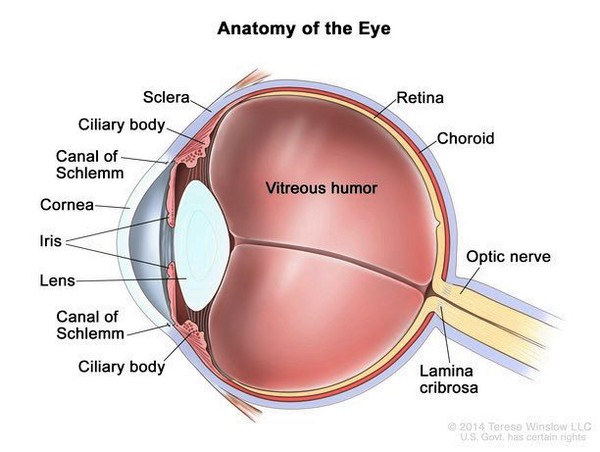 , which is the specialized tissue at the back of the eye that detects light and color.
In the retina, the CRB1 protein is critical for the normal development of light-sensing cells called photoreceptors. Studies suggest that this protein is part of a group (complex) of proteins that help determine the arrangement of photoreceptors within the retina and the position of various components within photoreceptors (cell polarity). The CRB1 protein may also be involved in forming connections between different types of cells in the retina.
Health Conditions Related to Genetic Changes
Leber congenital amaurosis
Genetic changes that cause disease are called pathogenic variants. Pathogenic variants in the CRB1 gene can cause Leber congenital amaurosis type 8. Leber congenital amaurosis is a group of eye disorders that affect the retina. People with Leber congenital amaurosis typically have severe vision loss that begins during the first year of life. Pathogenic variants in the CRB1 gene account for approximately 10 percent of all cases of Leber congenital amaurosis.
Most of the pathogenic variants in the CRB1 gene that are associated with Leber congenital amaurosis type 8 cause cells to make a version of the protein that does not function properly. The altered protein disrupts the organization and early development of the retina. As a result, the retina becomes unusually thick and does not develop the normal layered structure that is needed to process visual information. These changes cause the visual impairment that is characteristic of Leber congenital amaurosis type 8.
More About This Health ConditionCone-rod dystrophy
MedlinePlus Genetics provides information about Cone-rod dystrophy
More About This Health ConditionRetinitis pigmentosa
MedlinePlus Genetics provides information about Retinitis pigmentosa
More About This Health ConditionOther disorders
Some people with CRB1-associated retinal diseases, such as the conditions mentioned above, can develop round, coin-shaped pigmented deposits in the retina and a condition in which certain tissue around the retinal blood vessels remains healthy while other parts of the retina break down (para-arteriolar sparing). In addition, some affected individuals have small calcium deposits in the optic nerve (optic nerve drusen). These features are more common in people with CRB1-associated retinal disease than in people with other inherited retinal diseases.
In rare cases, pathogenic variants in the CRB1 gene can also cause pigmented paravenous retinochoroidal atrophy (PPRCA), which is characterized by the degeneration (atrophy) of the retina and its supporting layer of blood vessels and connective tissue (choroid).
Other Names for This Gene
- Crumbs cell polarity complex component 1
- Crumbs homolog 1
- LCA8
Additional Information & Resources
Tests Listed in the Genetic Testing Registry

Scientific Articles on PubMed
Catalog of Genes and Diseases from OMIM
References
- Antropoli A, Arrigo A, Pili L, Bianco L, Berni A, Saladino A, Bandello F, Battaglia Parodi M. Pigmented paravenous chorioretinal atrophy: Updated scenario. Eur J Ophthalmol. 2024 Jul;34(4):941-951. doi: 10.1177/11206721231199118. Epub 2023 Sep 5. Citation on PubMed
- Daich Varela M, Georgiou M, Alswaiti Y, Kabbani J, Fujinami K, Fujinami-Yokokawa Y, Khoda S, Mahroo OA, Robson AG, Webster AR, AlTalbishi A, Michaelides M. CRB1-Associated Retinal Dystrophies: Genetics, Clinical Characteristics, and Natural History. Am J Ophthalmol. 2023 Feb;246:107-121. doi: 10.1016/j.ajo.2022.09.002. Epub 2022 Sep 12. Citation on PubMed
- den Hollander AI, Davis J, van der Velde-Visser SD, Zonneveld MN, Pierrottet CO, Koenekoop RK, Kellner U, van den Born LI, Heckenlively JR, Hoyng CB, Handford PA, Roepman R, Cremers FP. CRB1 mutation spectrum in inherited retinal dystrophies. Hum Mutat. 2004 Nov;24(5):355-69. doi: 10.1002/humu.20093. Citation on PubMed
- den Hollander AI, Heckenlively JR, van den Born LI, de Kok YJ, van der Velde-Visser SD, Kellner U, Jurklies B, van Schooneveld MJ, Blankenagel A, Rohrschneider K, Wissinger B, Cruysberg JR, Deutman AF, Brunner HG, Apfelstedt-Sylla E, Hoyng CB, Cremers FP. Leber congenital amaurosis and retinitis pigmentosa with Coats-like exudative vasculopathy are associated with mutations in the crumbs homologue 1 (CRB1) gene. Am J Hum Genet. 2001 Jul;69(1):198-203. doi: 10.1086/321263. Epub 2001 May 24. Citation on PubMed or Free article on PubMed Central
- den Hollander AI, Roepman R, Koenekoop RK, Cremers FP. Leber congenital amaurosis: genes, proteins and disease mechanisms. Prog Retin Eye Res. 2008 Jul;27(4):391-419. doi: 10.1016/j.preteyeres.2008.05.003. Epub 2008 Jun 1. Citation on PubMed
- den Hollander AI, ten Brink JB, de Kok YJ, van Soest S, van den Born LI, van Driel MA, van de Pol DJ, Payne AM, Bhattacharya SS, Kellner U, Hoyng CB, Westerveld A, Brunner HG, Bleeker-Wagemakers EM, Deutman AF, Heckenlively JR, Cremers FP, Bergen AA. Mutations in a human homologue of Drosophila crumbs cause retinitis pigmentosa (RP12). Nat Genet. 1999 Oct;23(2):217-21. doi: 10.1038/13848. Citation on PubMed
- Gosens I, den Hollander AI, Cremers FP, Roepman R. Composition and function of the Crumbs protein complex in the mammalian retina. Exp Eye Res. 2008 May;86(5):713-26. doi: 10.1016/j.exer.2008.02.005. Epub 2008 Feb 26. Citation on PubMed
- Jacobson SG, Cideciyan AV, Aleman TS, Pianta MJ, Sumaroka A, Schwartz SB, Smilko EE, Milam AH, Sheffield VC, Stone EM. Crumbs homolog 1 (CRB1) mutations result in a thick human retina with abnormal lamination. Hum Mol Genet. 2003 May 1;12(9):1073-8. doi: 10.1093/hmg/ddg117. Citation on PubMed
- Kumaran N, Pennesi ME, Yang P, Trzupek KM, Michaelides M. Nonsyndromic Leber Congenital Amaurosis / Early-Onset Severe Retinal Dystrophy Overview. 2018 Oct 4 [updated 2025 Dec 4]. In: Adam MP, Bick S, Mirzaa GM, Wallace SE, Amemiya A, editors. GeneReviews(R) [Internet]. Seattle (WA): University of Washington, Seattle; 1993-2026. Available from http://www.ncbi.nlm.nih.gov/books/NBK531510/ Citation on PubMed
- Lotery AJ, Jacobson SG, Fishman GA, Weleber RG, Fulton AB, Namperumalsamy P, Heon E, Levin AV, Grover S, Rosenow JR, Kopp KK, Sheffield VC, Stone EM. Mutations in the CRB1 gene cause Leber congenital amaurosis. Arch Ophthalmol. 2001 Mar;119(3):415-20. doi: 10.1001/archopht.119.3.415. Citation on PubMed
- Richard M, Roepman R, Aartsen WM, van Rossum AG, den Hollander AI, Knust E, Wijnholds J, Cremers FP. Towards understanding CRUMBS function in retinal dystrophies. Hum Mol Genet. 2006 Oct 15;15 Spec No 2:R235-43. doi: 10.1093/hmg/ddl195. Citation on PubMed
- Saberi M, Golchehre Z, Karamzade A, Entezam M, Eshaghkhani Y, Alavinejad E, Khojasteh Jafari H, Keramatipour M. CRB1-Related Leber Congenital Amaurosis: Reporting Novel Pathogenic Variants and a Brief Review on Mutations Spectrum. Iran Biomed J. 2019 Sep;23(5):362-8. doi: 10.29252/.23.5.362. Epub 2019 May 19. Citation on PubMed
- van de Pavert SA, Kantardzhieva A, Malysheva A, Meuleman J, Versteeg I, Levelt C, Klooster J, Geiger S, Seeliger MW, Rashbass P, Le Bivic A, Wijnholds J. Crumbs homologue 1 is required for maintenance of photoreceptor cell polarization and adhesion during light exposure. J Cell Sci. 2004 Aug 15;117(Pt 18):4169-77. doi: 10.1242/jcs.01301. Citation on PubMed
The information on this site should not be used as a substitute for professional medical care or advice. Contact a health care provider if you have questions about your health.