



Normal Function
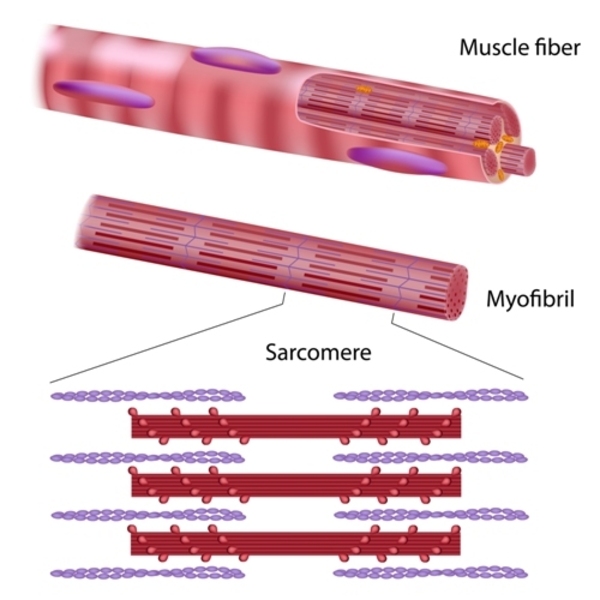
The MYOT gene provides instructions for making a protein called myotilin. Myotilin is found in heart (cardiac) muscle and in the muscles used for movement (skeletal muscle). Within muscle fibers, structures called sarcomeres generate the force needed for muscles to contract. Sarcomeres are linked together by structures called Z-discs to form myofibrils, which are the basic units of muscle fibers. Myotilin is found within Z-discs, where it binds with other proteins to help organize and stabilize the sarcomeres. The organization of sarcomeres and myofibrils provides the strength and stability that is needed during repeated cycles of muscle contraction and relaxation.
Health Conditions Related to Genetic Changes
Myofibrillar myopathy
Variants (also called mutations) in the MYOT gene can cause myofibrillar myopathy. This condition is characterized by muscle weakness (myopathy) that worsens over time. Approximately 10 percent of people with myofibrillar myopathy have a variant in the MYOT gene. Most of these variants lead to the substitution of one protein building block (amino acid) for another in myotilin, which causes cells to produce a version of the protein that does not function properly. The altered protein impairs the function of Z-discs, which disrupts the organization and structure of myofibrils. Myofibrils that are not organized correctly break down and form clumps (aggregates) of abnormal proteins within the sarcomere, which leads to the myopathy seen in people with myofibrillar myopathy.
More About This Health ConditionOther Names for This Gene
- TTID
Additional Information & Resources
Tests Listed in the Genetic Testing Registry

Scientific Articles on PubMed
Catalog of Genes and Diseases from OMIM
References
- Ferrer I, Olive M. Molecular pathology of myofibrillar myopathies. Expert Rev Mol Med. 2008 Sep 3;10:e25. doi: 10.1017/S1462399408000793. Citation on PubMed
- Fichna JP, Maruszak A, Zekanowski C. Myofibrillar myopathy in the genomic context. J Appl Genet. 2018 Nov;59(4):431-439. doi: 10.1007/s13353-018-0463-4. Epub 2018 Sep 10. Citation on PubMed
- Maerkens A, Olive M, Schreiner A, Feldkirchner S, Schessl J, Uszkoreit J, Barkovits K, Guttsches AK, Theis V, Eisenacher M, Tegenthoff M, Goldfarb LG, Schroder R, Schoser B, van der Ven PF, Furst DO, Vorgerd M, Marcus K, Kley RA. New insights into the protein aggregation pathology in myotilinopathy by combined proteomic and immunolocalization analyses. Acta Neuropathol Commun. 2016 Feb 3;4:8. doi: 10.1186/s40478-016-0280-0. Citation on PubMed
- Savarese M, Sarparanta J, Vihola A, Jonson PH, Johari M, Rusanen S, Hackman P, Udd B. Panorama of the distal myopathies. Acta Myol. 2020 Dec 1;39(4):245-265. doi: 10.36185/2532-1900-028. eCollection 2020 Dec. Citation on PubMed
- Schroder R, Schoser B. Myofibrillar myopathies: a clinical and myopathological guide. Brain Pathol. 2009 Jul;19(3):483-92. doi: 10.1111/j.1750-3639.2009.00289.x. Citation on PubMed
- Selcen D, Engel AG. Mutations in myotilin cause myofibrillar myopathy. Neurology. 2004 Apr 27;62(8):1363-71. doi: 10.1212/01.wnl.0000123576.74801.75. Citation on PubMed
- von Nandelstadh P, Soliymani R, Baumann M, Carpen O. Analysis of myotilin turnover provides mechanistic insight into the role of myotilinopathy-causing mutations. Biochem J. 2011 May 15;436(1):113-21. doi: 10.1042/BJ20101672. Citation on PubMed
The information on this site should not be used as a substitute for professional medical care or advice. Contact a health care provider if you have questions about your health.