



Description
SOST-related sclerosing bone dysplasias are disorders of bone development that are characterized by abnormal hardening (sclerosis) of the bone and increased bone formation (hyperostosis). As a result, bones throughout the body may be denser and wider than normal. The bones of the skull, lower jaw (mandible), arms, and legs are particularly affected. The hyperostosis typically worsens over time as bone formation continues, which causes certain skeletal features to become more pronounced with age.
There are two forms of SOST-related sclerosing bone dysplasia: SOST-related sclerosteosis and van Buchem disease (also called SOST-related endosteal hyperostosis, van Buchem type).
Infants with SOST-related sclerosteosis typically have webbed or fused fingers (syndactyly) at birth. As children grow, hyperostosis of the bones in the skull may cause individuals with SOST-related sclerosteosis to have a sunken appearance to the middle of the face (midface hypoplasia), bulging eyes with shallow eye sockets (ocular proptosis), and a prominent forehead. People with this condition typically also have an enlarged jaw with misaligned teeth. Beginning in childhood, affected individuals may be taller than their peers due to their longer legs.
Hyperostosis of the skull bones in people with SOST-related sclerosteosis can compress the cranial nerves, which emerge from the brain and extend to various areas of the head and neck. Compression of the cranial nerves can lead to paralysis of the facial muscles (facial palsy), vision loss, hearing loss, and a sense of smell that is diminished (hyposmia) or completely absent (anosmia). The increased thickness of the skull bones can also increase the pressure on parts of the brain, which can cause headaches. This pressure can also cause life-threatening complications if it compresses the part of the brain that is connected to the spinal cord (the brainstem). Because of these potentially serious health consequences, people with SOST-related sclerosteosis may have a shortened lifespan.
The features seen in people with van Buchem disease tend to be less severe than those seen in people with SOST-related sclerosteosis. People with van Buchem disease are typically of average height and do not have syndactyly. Compression of the cranial nerves is common in people with van Buchem disease, often causing facial palsy and hearing loss. Increased pressure on parts of the brain is rare. Van Buchem disease does not appear to affect life expectancy.
Frequency
SOST-related sclerosing bone dysplasias are rare. Approximately 100 cases of SOST-related sclerosteosis have been reported in the scientific literature. This condition appears to be most common in the Afrikaner population of South Africa, where as many as 1 in 60,000 people may have the condition.
Fewer than 50 cases of van Buchem disease have been reported in the medical literature. This condition is found almost exclusively in people from the Netherlands.
Causes
Genetic changes in or near the SOST gene cause SOST-related sclerosing bone dysplasias. The SOST gene provides instructions for making the protein sclerostin. Sclerostin is produced in bone cells called osteocytes and plays an important role in bone formation.
Bone remodeling is a normal process in which old bone is broken down and new bone is formed. Bone remodeling is carefully controlled to ensure that bones stay strong and healthy. It requires a balance between the formation of new bone tissue and the breakdown and removal (resorption) of old bone tissue. The main function of sclerostin is to stop (inhibit) bone formation. Inhibiting bone formation helps to ensure that bones are the correct shape, size, and density.
The changes in the SOST gene that cause SOST-related sclerosteosis are known as "loss-of-function variants" because they reduce the activity of sclerostin or decrease the amount of sclerostin that is produced by cells. This disrupts the ability to inhibit bone formation, causing the hyperostosis seen in people with SOST-related sclerosteosis.
Changes in the DNA near the SOST gene cause van Buchem disease. The most common change in people with van Buchem disease is the deletion of a region of DNA that normally helps regulate the activity (expression) of the SOST gene. This decreases SOST gene expression and reduces protein production, which leads to a shortage of functional sclerostin protein and causes the hyperostosis seen in people with van Buchem disease.
Inheritance
SOST-related sclerosing bone dysplasias are inherited in an autosomal recessive pattern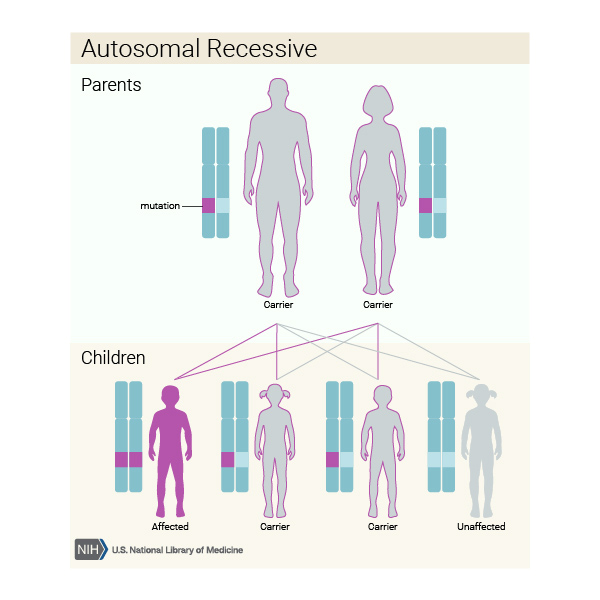 , which means that the genetic change must be present in both copies of the gene in each cell to cause the disorder. The parents of an individual with an autosomal recessive condition each carry one copy of the altered gene, but they typically do not show signs and symptoms of the condition.
Other Names for This Condition
Additional Information & Resources
Genetic Testing Information

Genetic and Rare Diseases Information Center
Patient Support and Advocacy Resources
Catalog of Genes and Diseases from OMIM
Scientific Articles on PubMed
References
- Appelman-Dijkstra N, Van Lierop A, Papapoulos S. SOST-Related Sclerosing Bone Dysplasias. 2002 Jun 4 [updated 2024 Aug 1]. In: Adam MP, Bick S, Mirzaa GM, Pagon RA, Wallace SE, Amemiya A, editors. GeneReviews(R) [Internet]. Seattle (WA): University of Washington, Seattle; 1993-2026. Available from http://www.ncbi.nlm.nih.gov/books/NBK587318/ Citation on PubMed
- Balemans W, Van Hul W. Human genetics of SOST. J Musculoskelet Neuronal Interact. 2006 Oct-Dec;6(4):355-6. No abstract available. Citation on PubMed
- Ekhzaimy AA, Alyusuf EY, Alswailem M, Alzahrani AS. A Novel Mutation in a Gene Causes Sclerosteosis in a Family of Mediterranean Origin. Medicina (Kaunas). 2022 Jan 28;58(2):202. doi: 10.3390/medicina58020202. Citation on PubMed
- Gardner JC, van Bezooijen RL, Mervis B, Hamdy NA, Lowik CW, Hamersma H, Beighton P, Papapoulos SE. Bone mineral density in sclerosteosis; affected individuals and gene carriers. J Clin Endocrinol Metab. 2005 Dec;90(12):6392-5. doi: 10.1210/jc.2005-1235. Epub 2005 Sep 27. Citation on PubMed
- Hamersma H, Gardner J, Beighton P. The natural history of sclerosteosis. Clin Genet. 2003 Mar;63(3):192-7. doi: 10.1034/j.1399-0004.2003.00036.x. Citation on PubMed
- Piters E, Culha C, Moester M, Van Bezooijen R, Adriaensen D, Mueller T, Weidauer S, Jennes K, de Freitas F, Lowik C, Timmermans JP, Van Hul W, Papapoulos S. First missense mutation in the SOST gene causing sclerosteosis by loss of sclerostin function. Hum Mutat. 2010 Jul;31(7):E1526-43. doi: 10.1002/humu.21274. Citation on PubMed
- Sebastian A, Loots GG. Genetics of Sost/SOST in sclerosteosis and van Buchem disease animal models. Metabolism. 2018 Mar;80:38-47. doi: 10.1016/j.metabol.2017.10.005. Epub 2017 Oct 25. Citation on PubMed
- Unger S, Ferreira CR, Mortier GR, Ali H, Bertola DR, Calder A, Cohn DH, Cormier-Daire V, Girisha KM, Hall C, Krakow D, Makitie O, Mundlos S, Nishimura G, Robertson SP, Savarirayan R, Sillence D, Simon M, Sutton VR, Warman ML, Superti-Furga A. Nosology of genetic skeletal disorders: 2023 revision. Am J Med Genet A. 2023 May;191(5):1164-1209. doi: 10.1002/ajmg.a.63132. Epub 2023 Feb 13. Citation on PubMed
- van Bezooijen RL, ten Dijke P, Papapoulos SE, Lowik CW. SOST/sclerostin, an osteocyte-derived negative regulator of bone formation. Cytokine Growth Factor Rev. 2005 Jun;16(3):319-27. doi: 10.1016/j.cytogfr.2005.02.005. Citation on PubMed
- van Lierop AH, Appelman-Dijkstra NM, Papapoulos SE. Sclerostin deficiency in humans. Bone. 2017 Mar;96:51-62. doi: 10.1016/j.bone.2016.10.010. Epub 2016 Oct 11. Citation on PubMed
- Whyte MP, Deepak Amalnath S, McAlister WH, Pedapati R, Muthupillai V, Duan S, Huskey M, Bijanki VN, Mumm S. Sclerosteosis: Report of type 1 or 2 in three Indian Tamil families and literature review. Bone. 2018 Nov;116:321-332. doi: 10.1016/j.bone.2018.07.022. Epub 2018 Aug 2. Citation on PubMed
The information on this site should not be used as a substitute for professional medical care or advice. Contact a health care provider if you have questions about your health.