



Description
Dysequilibrium syndrome (DES) is a group of disorders that are characterized by abnormal brain development, which causes intellectual disabilities and problems with balance and coordination (ataxia). The specific signs and symptoms and the severity of the condition can vary among affected individuals.
In people with DES, the part of the brain that coordinates movement (cerebellum) may be unusually small and underdeveloped (cerebellar hypoplasia). This can lead to ataxia that is present from birth and typically does not worsen over time. Additional brain abnormalities may include further loss of tissue (atrophy) in the cerebellum; fewer folds and grooves (gyri) on the surface of the brain; and a small brainstem, which is the area of the brain that connects the brain to the spinal cord.
Children with DES may have low muscle tone (hypotonia) and delayed development of motor skills such as walking. Some affected individuals learn to walk later in childhood, while others are never able to walk independently.
Additional features of DES may include intellectual disabilities that can vary from mild to profound; rapid, involuntary eye movements (nystagmus); and eyes that do not look in the same direction (strabismus). People with DES may also have difficulty speaking (dysarthria) or be unable to speak. Flat feet (pes planus), seizures, and short stature have been reported in some people with DES.
Frequency
The exact prevalence of DES is unknown, but more than 75 cases have been reported in the medical literature.
Causes
Certain variants (also called mutations) in one of several genes cause DES. There are at least four types of DES, each with a different genetic cause. Variants in the VLDLR gene cause a form of DES called type 1, also sometimes called VLDLR-related cerebellar hypoplasia. This is the most common form of DES.
The VLDLR gene provides instructions for making a protein called a very low-density lipoprotein (VLDL) receptor. This protein plays a critical role in guiding developing nerve cells to the appropriate locations in the brain. Many of the variants in the VLDLR gene that are associated with DES type 1 prevent cells from producing any functional VLDL receptor protein. Without this protein, developing nerve cells cannot reach the parts of the brain where they are needed. This impairs brain development, which leads to the intellectual disabilities and ataxia seen in people with this condition.
Variants in different genes cause the other types of DES and are each responsible for a small percentage of cases.
Inheritance
DES is inherited in an autosomal recessive pattern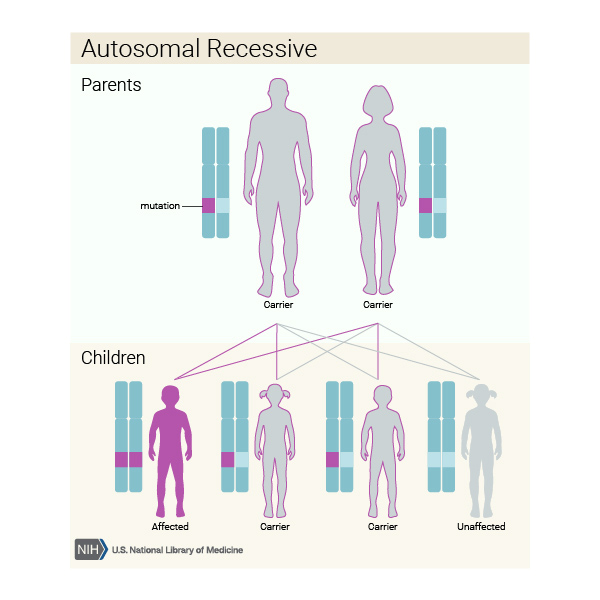 , which means both copies of the gene in each cell must have a variant to cause the disorder. The parents of an individual with an autosomal recessive condition each carry one copy of the altered gene, but they typically do not show signs and symptoms of the condition.
Other Names for This Condition
- CAMRQ
- CAMRQ syndrome
- Cerebellar ataxia, impaired intellectual development, and dysequilibrium syndrome
- Cerebellar ataxia-intellectual disability-dysequilibrium syndrome
- DES
- Non-progressive cerebellar ataxia-intellectual disability syndrome
Additional Information & Resources
Genetic Testing Information

Patient Support and Advocacy Resources
Clinical Trials
Catalog of Genes and Diseases from OMIM
- CEREBELLAR ATAXIA, IMPAIRED INTELLECTUAL DEVELOPMENT, AND DYSEQUILIBRIUM SYNDROME 1; CAMRQ1
- CEREBELLAR ATAXIA, IMPAIRED INTELLECTUAL DEVELOPMENT, AND DYSEQUILIBRIUM SYNDROME 2; CAMRQ2
- CEREBELLAR ATAXIA, IMPAIRED INTELLECTUAL DEVELOPMENT, AND DYSEQUILIBRIUM SYNDROME 4; CAMRQ4
- SPINOCEREBELLAR ATAXIA, AUTOSOMAL RECESSIVE 34; SCAR34
Scientific Articles on PubMed
References
- Boycott KM, Bonnemann C, Herz J, Neuert S, Beaulieu C, Scott JN, Venkatasubramanian A, Parboosingh JS. Mutations in VLDLR as a cause for autosomal recessive cerebellar ataxia with mental retardation (dysequilibrium syndrome). J Child Neurol. 2009 Oct;24(10):1310-5. doi: 10.1177/0883073809332696. Epub 2009 Mar 30. Citation on PubMed or Free article on PubMed Central
- Boycott KM, Flavelle S, Bureau A, Glass HC, Fujiwara TM, Wirrell E, Davey K, Chudley AE, Scott JN, McLeod DR, Parboosingh JS. Homozygous deletion of the very low density lipoprotein receptor gene causes autosomal recessive cerebellar hypoplasia with cerebral gyral simplification. Am J Hum Genet. 2005 Sep;77(3):477-83. doi: 10.1086/444400. Epub 2005 Jul 22. Citation on PubMed or Free article on PubMed Central
- Boycott KM, MacDonald SK, Parboosingh JS. VLDLR Cerebellar Hypoplasia. 2008 Aug 26 [updated 2020 Feb 27]. In: Adam MP, Bick S, Mirzaa GM, Wallace SE, Amemiya A, editors. GeneReviews(R) [Internet]. Seattle (WA): University of Washington, Seattle; 1993-2026. Available from http://www.ncbi.nlm.nih.gov/books/NBK1874/ Citation on PubMed
- Breuss MW, Nguyen T, Srivatsan A, Leca I, Tian G, Fritz T, Hansen AH, Musaev D, McEvoy-Venneri J, James KN, Rosti RO, Scott E, Tan U, Kolodner RD, Cowan NJ, Keays DA, Gleeson JG. Uner Tan syndrome caused by a homozygous TUBB2B mutation affecting microtubule stability. Hum Mol Genet. 2017 Jan 15;26(2):258-269. doi: 10.1093/hmg/ddw383. Citation on PubMed
- Kaiyrzhanov R, Ortigoza-Escobar JD, Stringer BW, Ganieva M, Gowda VK, Srinivasan VM, Macaya A, Laner A, Onbool E, Al-Shammari R, Al-Owain M, Deconinck N, Vilain C, Dontaine P, Self E, Akram R, Hussain G, Baig SM, Iqbal J, Salpietro V, Neshatdoust M, Kasiri M, Yesil G, Uygur T, Pysden K, Berry IR, Alves CA, Giacomotto J, Houlden H, Maroofian R. Clinical and Molecular Spectrum of Autosomal Recessive CA8-Related Cerebellar Ataxia. Mov Disord. 2024 Jun;39(6):983-995. doi: 10.1002/mds.29754. Epub 2024 Apr 6. Citation on PubMed
- Komara M, John A, Suleiman J, Ali BR, Al-Gazali L. Clinical and molecular delineation of dysequilibrium syndrome type 2 and profound sensorineural hearing loss in an inbred Arab family. Am J Med Genet A. 2016 Feb;170A(2):540-543. doi: 10.1002/ajmg.a.37421. Epub 2015 Oct 5. No abstract available. Citation on PubMed
- Matsell E, Mazaheri M, Andersen JP, Molday RS. Structural and functional properties of the N- and C-terminal segments of the P4-ATPase phospholipid flippase ATP8A2. J Biol Chem. 2025 Jan;301(1):108065. doi: 10.1016/j.jbc.2024.108065. Epub 2024 Dec 9. Citation on PubMed
- Micalizzi A, Moroni I, Ginevrino M, Biagini T, Mazza T, Romani M, Valente EM. Very mild features of dysequilibrium syndrome associated with a novel VLDLR missense mutation. Neurogenetics. 2016 Jul;17(3):191-5. doi: 10.1007/s10048-016-0488-y. Epub 2016 Jun 2. Citation on PubMed
- Mohamadian M, Ghandil P, Naseri M, Bahrami A, Momen AA. A novel homozygous variant in an Iranian pedigree with cerebellar ataxia, mental retardation, and dysequilibrium syndrome type 4. J Clin Lab Anal. 2020 Nov;34(11):e23484. doi: 10.1002/jcla.23484. Epub 2020 Jul 17. Citation on PubMed
- Moheb LA, Tzschach A, Garshasbi M, Kahrizi K, Darvish H, Heshmati Y, Kordi A, Najmabadi H, Ropers HH, Kuss AW. Identification of a nonsense mutation in the very low-density lipoprotein receptor gene (VLDLR) in an Iranian family with dysequilibrium syndrome. Eur J Hum Genet. 2008 Feb;16(2):270-3. doi: 10.1038/sj.ejhg.5201967. Epub 2007 Nov 28. Citation on PubMed
- Newman JM, Vogel H. Neuropathological findings of very low-density lipoprotein receptor-related cerebellar hypoplasia in a full-term fetus. J Neuropathol Exp Neurol. 2025 Dec 1;84(12):1135-1142. doi: 10.1093/jnen/nlaf110. Citation on PubMed
- Richmond CM, Leventer R, Ryan MM, Delatycki MB. Cerebellar ataxia with normal intellect associated with a homozygous truncating variant in CA8. Clin Genet. 2020 Mar;97(3):516-520. doi: 10.1111/cge.13666. Epub 2019 Nov 14. Citation on PubMed
- Teov B, Janchevska A, Beqiri-Jasari A, Tasic V, Kungulovski G, Gucev Z. Compound Heterozygosity in Cerebellar Ataxia, Mental Retardation, and Disequilibrium Syndrome Type 4. Pril (Makedon Akad Nauk Umet Odd Med Nauki). 2023 Dec 18;44(3):85-90. doi: 10.2478/prilozi-2023-0051. Print 2023 Dec 1. Citation on PubMed
- Turkmen S, Hoffmann K, Demirhan O, Aruoba D, Humphrey N, Mundlos S. Cerebellar hypoplasia, with quadrupedal locomotion, caused by mutations in the very low-density lipoprotein receptor gene. Eur J Hum Genet. 2008 Sep;16(9):1070-4. doi: 10.1038/ejhg.2008.73. Epub 2008 Mar 26. Citation on PubMed
- Wali GM, Wali G. Broadening the Clinical Spectrum of Very Low Density Lipoprotein Receptor Associated Dysequilibrium Syndrome. Mov Disord Clin Pract. 2021 Apr 3;8(4):619-623. doi: 10.1002/mdc3.13184. eCollection 2021 May. No abstract available. Citation on PubMed
The information on this site should not be used as a substitute for professional medical care or advice. Contact a health care provider if you have questions about your health.