



A heart murmur is a blowing, whooshing, or rasping sound heard during a heartbeat. The sound is caused by turbulent (rough) blood flow through the heart valves or near the heart.
Considerations
The heart has 4 chambers:
- Two upper chambers (atria)
- Two lower chambers (ventricles)
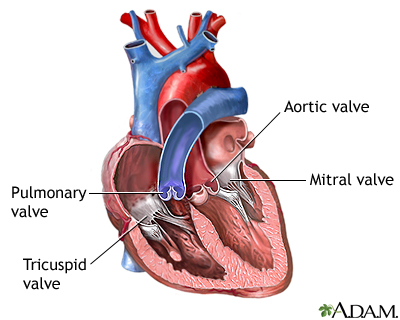
The heart has valves that close with each heartbeat, causing blood to flow in only one direction. Two of the valves are located between the chambers (mitral and tricuspid). The other two valves (aortic and pulmonic) are located at the exit from the heart chambers into the aorta and pulmonary artery, respectively.
 Watch this video about:Heartbeat
Murmurs can happen for many reasons, such as:
- When a valve does not close tightly and blood leaks backward (regurgitation)
- When blood flows through a narrowed or stiff heart valve (stenosis)
There are several ways in which your health care provider may describe a murmur:
- Murmurs are classified ("graded") depending on how loud the murmur sounds with a stethoscope. The grading is on a scale. Grade I can barely be heard and is intermittent. An example of a murmur description is a "grade II/VI murmur." (This means the murmur is grade 2 on a scale of 1 to 6).
- In addition, a murmur is described by the stage of the heartbeat when the murmur is heard. A heart murmur may be described as systolic or diastolic. (Systole is when the heart is squeezing out blood and diastole is when it is filling up with blood.)
When a murmur is more noticeable, the provider may be able to feel it with the palm of the hand over the heart. This is called a "thrill" and means the murmur is grade 4 or higher.
Things the provider will look for in the exam include:
- Does the murmur occur when the heart is resting or contracting?
- Does it last throughout the heartbeat?
- Does it change when you move?
- Can it be heard in other parts of the chest, on the back, or in the neck?
- Where is the murmur heard the loudest?
Causes
Many heart murmurs are harmless. These types of murmurs are called innocent murmurs. They will not cause any symptoms or problems. Innocent murmurs do not need specific cardiac treatment.
Any situation in which there is additional blood flow through the heart may cause a murmur. Examples include during or after exercise/physical activity, during pregnancy, high emotional stress, fever/illness, anemia, or hyperthyroidism.
Other heart murmurs may indicate an abnormality in the heart. These abnormal murmurs can be caused by:
- Problems of the aortic valve (aortic regurgitation, aortic stenosis)
- Problems of the mitral valve (chronic or acute mitral regurgitation, mitral stenosis)
- Hypertrophic cardiomyopathy
- Pulmonary regurgitation (backflow of blood into the right ventricle, caused by failure of the pulmonary valve to close completely)
- Pulmonary valve stenosis
- Problems of the tricuspid valve (tricuspid regurgitation, tricuspid stenosis)
Significant murmurs in children are more likely to be caused by:
- Anomalous pulmonary venous return (an abnormal formation of the pulmonary veins)
- Atrial septal defect (ASD)
- Coarctation of the aorta
- Patent ductus arteriosus (PDA)
- Ventricular septal defect (VSD)
Multiple murmurs may result from a combination of heart problems.
Children often have murmurs as a normal part of development. These murmurs do not need treatment. They may include:
- Pulmonary flow murmurs
- Still's murmur
- Venous hum
What to Expect at Your Office Visit
A provider can listen to your heart sounds by placing a stethoscope on your chest. You will be asked questions about your medical history and symptoms, such as:
- Have other family members had murmurs or other abnormal heart sounds?
- Do you have a family history of heart problems?
- Do you have chest pain, fainting, shortness of breath, or other breathing problems?
- Have you had swelling, weight gain, or bulging veins in the neck?
- Does your skin ever have a bluish color (cyanosis)?
The provider may ask you to squat, stand, or hold your breath while bearing down or gripping something with your hands to listen to your heart.
The following tests may be done:
Alternative Names
Chest sounds - murmurs; Heart sounds - abnormal; Murmur - innocent; Innocent murmur; Systolic heart murmur; Diastolic heart murmur


References
Fang JC, Metkus TS, O'Gara PT. History, physical examination and the virtual visit. In: Bonow RO, Mann DL, Tomaselli GF, et al, eds. Braunwald's Heart Disease: A Textbook of Cardiovascular Medicine. 13th ed. Philadelphia, PA: Elsevier; 2026:chap 11.
Goldman L. Approach to the patient with possible cardiovascular disease. In: Goldman L, Cooney KA, eds. Goldman-Cecil Medicine. 27th ed. Philadelphia, PA: Elsevier; 2024:chap 39.
Swartz MH. The heart. In: Swartz MH, ed. Swartz Textbook of Physical Diagnosis: History and Examination. 9th ed. Philadelphia, PA: Elsevier; 2026:chap 14.
Writing Committee Members, Otto CM, Nishimura RA, et al. 2020 ACC/AHA guideline for the management of patients with valvular heart disease: a report of the American College of Cardiology/American Heart Association Joint Committee on Clinical Practice Guidelines. J Am Coll Cardiol. 2021;77(4):e25-197. PMID: 33342586 pubmed.ncbi.nlm.nih.gov/33342586/.
Review Date 4/28/2026
Updated by: Michael A. Chen, MD, PhD, Associate Professor of Medicine, Division of Cardiology, Harborview Medical Center, University of Washington Medical School, Seattle, WA. Also reviewed by David C. Dugdale, MD, Medical Director, Brenda Conaway, Editorial Director, and the A.D.A.M. Editorial team.